
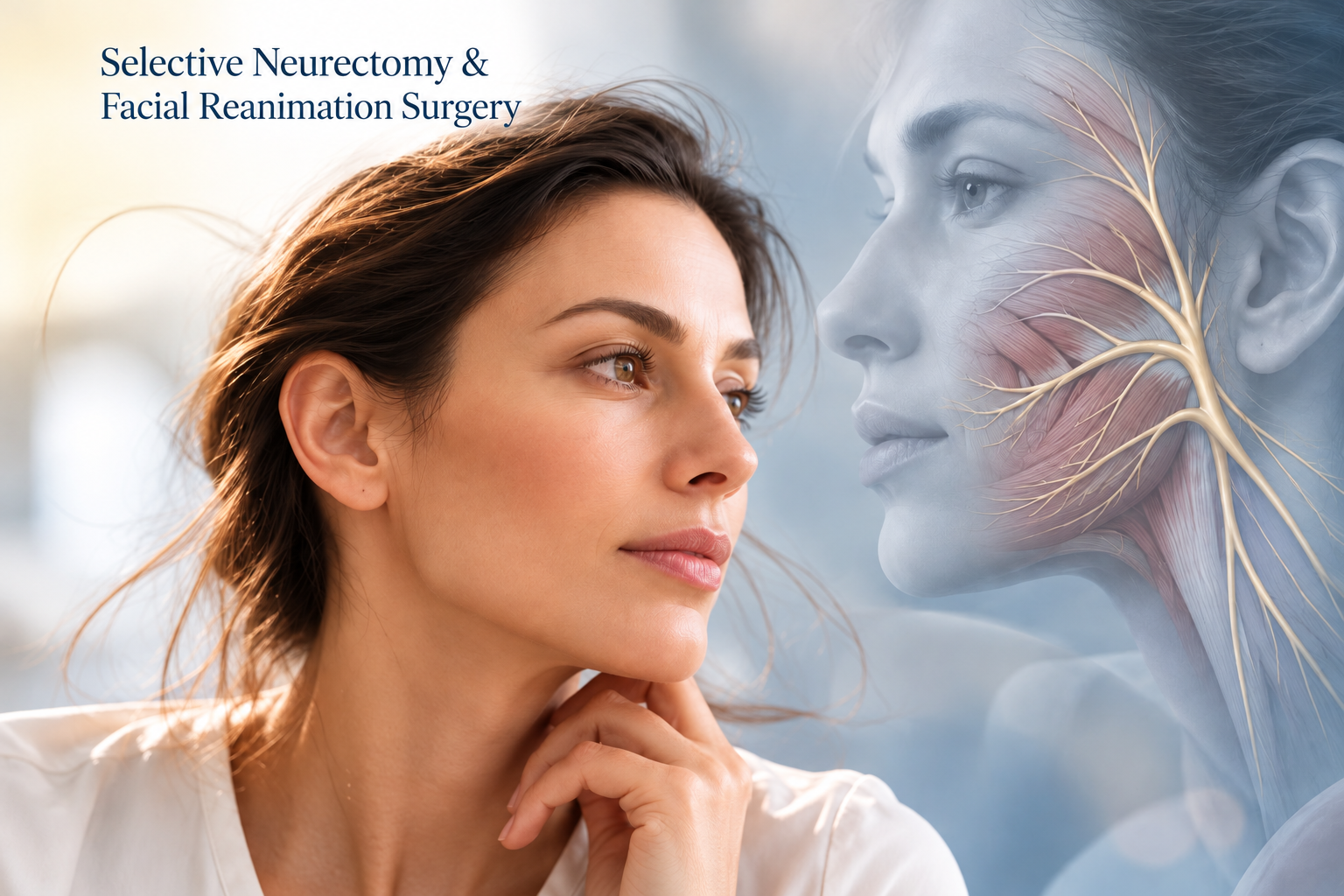
Selective Neurectomy & Facial Reanimation Surgery in Turkey
Selective Neurectomy and Facial Reanimation Surgery in Turkey
Facial paralysis is not one single surgical problem, and facial reanimation is not one single operation.
Some patients have almost no movement on one side of the face. Others have recovered movement after Bell’s palsy, surgery or another facial nerve injury, but the movement has returned in an abnormal pattern. They may experience facial tightness, involuntary eye closure when smiling, pulling around the mouth, neck contraction or an asymmetric smile.
These situations require very different surgical strategies.
For patients with facial synkinesis and preserved facial movement, selective neurectomy may sometimes be considered. For patients with severe or long-standing flaccid facial paralysis, treatment may instead involve nerve transfer, nerve grafting, cross-facial nerve grafting, temporalis tendon transfer or free functional muscle transfer such as gracilis reconstruction.
The important question is therefore not simply: “Which facial paralysis surgery is best?”
It is: “What function remains, what has been lost, and what exactly needs to be reconstructed?”
Facial Synkinesis Is Different From Complete Facial Paralysis
Facial synkinesis usually develops after the facial nerve has been injured and subsequently regenerates in an abnormal pattern.
The facial muscles may still move, but different muscle groups contract together when they should work independently.
A patient may smile and unintentionally close the eye. The neck may tighten during facial expression. Muscles that pull the corner of the mouth downward may become overactive and restrict the smile.
This is fundamentally different from a face in which the muscles no longer receive sufficient functional nerve input.
That distinction is critical because a patient with useful facial movement may benefit from rebalancing existing movement, while a patient without useful movement may need new nerve input or even a new functioning muscle.
What Is Selective Neurectomy?
Selective neurectomy is a surgical technique used in selected patients with non-flaccid facial paralysis and synkinesis.
Instead of replacing the facial nerve or transferring a new muscle, the surgeon identifies selected facial nerve branches that contribute to unwanted or counterproductive muscle activity.
These branches can then be selectively reduced while preserving nerve pathways responsible for useful facial movement.
Modified selective neurectomy is particularly associated with attempts to improve smile balance by reducing abnormal activation of muscles that oppose the upward and outward movement of the mouth.
Depending on the individual facial pattern, selective neurectomy may also be combined with procedures addressing overactive muscles, such as selective myectomy or treatment of the platysma.
Who May Be Considered for Selective Neurectomy?
Selective neurectomy is not primarily designed for a completely immobile face.
It may be considered when a patient has recovered facial movement but continues to experience significant synkinesis, facial tightness or abnormal muscular co-contraction despite appropriate non-surgical treatment.
Before surgery, many patients have already undergone facial neuromuscular retraining and botulinum toxin treatment. These treatments remain important because surgery is generally reserved for selected patients whose symptoms remain significant or who are seeking a more durable surgical strategy.
Selective Neurectomy vs Nerve Transfer
The difference between these procedures is important.
Selective neurectomy works with an existing facial nerve system that is functioning, but functioning abnormally.
A nerve transfer is usually considered when facial nerve input is inadequate and another motor nerve is used to provide a new source of movement.
One example is a masseteric-to-facial nerve transfer, in which a branch of the nerve controlling the chewing muscle is connected to the facial nerve system to help restore facial movement.
The goal is therefore different: selective neurectomy reduces unwanted activity, whereas nerve transfer attempts to provide new motor input.
What Is a Cross-Facial Nerve Graft?
A cross-facial nerve graft uses facial nerve activity from the healthy side of the face to provide a neural signal to the affected side.
A nerve graft is placed across the face and can later be connected to the facial nerve system or to a transferred muscle.
One of the reasons this technique remains important in facial reanimation is its potential to use the natural facial nerve signal from the unaffected side, particularly when surgeons are trying to recreate a more spontaneous smile.
Cross-facial nerve grafting may be performed as part of a staged reconstruction, particularly when combined with a free functional muscle transfer.
When Is Nerve Grafting Used?
Direct facial nerve repair or interposition nerve grafting may be appropriate when the facial nerve has been disrupted but the anatomy and timing still allow reconstruction of the nerve pathway.
This situation can occur after trauma, tumour surgery or other injuries affecting facial nerve continuity.
The surgical strategy depends heavily on where the nerve has been damaged, how much time has passed and whether the facial muscles remain capable of responding to reinnervation.
Gracilis Free Muscle Transfer for Long-Standing Facial Paralysis
In long-standing facial paralysis, the original facial muscles may eventually lose the ability to produce useful movement even if a new nerve source is provided.
In these cases, surgeons may need to reconstruct both the motor source and the muscle responsible for movement.
A free functional gracilis muscle transfer involves transferring a small segment of gracilis muscle from the inner thigh to the face together with its blood vessels and nerve.
The transferred muscle is positioned to recreate movement of the oral commissure and smile.
It can be powered by different nerve sources, including the masseteric nerve, a cross-facial nerve graft or, in selected reconstruction strategies, combinations of nerve inputs.
This is a substantially different operation from selective neurectomy. Selective neurectomy aims to improve abnormal movement that already exists; gracilis reconstruction creates a new dynamic system when useful native movement is no longer available.
Temporalis Tendon Transfer
Another option for dynamic smile reconstruction is temporalis tendon transfer.
The temporalis is one of the muscles used for chewing. Its tendon can be redirected toward the corner of the mouth to create movement and improve facial symmetry.
Unlike free muscle transfer, it uses a functioning regional muscle already present in the face rather than transferring muscle tissue from another part of the body.
It can therefore be an important option in selected patients with chronic facial paralysis, depending on the desired movement, previous procedures, medical condition and reconstructive goals.
Facial Reanimation Is Not Only About the Smile
Protecting the eye can be just as important as restoring smile movement.
Facial paralysis may impair eyelid closure, tear distribution and lower eyelid support, potentially exposing the cornea.
Depending on the severity of the problem, treatment may include procedures such as upper eyelid weight placement, lower eyelid support procedures or other eyelid reconstruction techniques.
In complex facial paralysis, smile reconstruction and eye protection may therefore form different parts of the same overall facial reanimation plan.
How Is the Right Facial Reanimation Procedure Chosen?
The choice of operation cannot be made from the diagnosis alone.
A facial reanimation surgeon needs to understand:
- How long the facial paralysis has been present
- Whether the paralysis is complete or incomplete
- Whether synkinesis is present
- Which facial muscles still move
- The pattern of smile asymmetry
- Whether the eye closes adequately
- Previous facial nerve surgery
- Previous botulinum toxin treatment or facial rehabilitation
- The condition and continuity of the facial nerve
- The patient’s functional priorities
Clinical examination is central. Depending on the case, previous operative reports, photographs, facial movement videos, imaging or electrophysiological assessment may also contribute to surgical planning.
Selective Neurectomy Is Not a Substitute for Full Facial Reanimation
This is one of the most important distinctions for patients researching treatment.
A patient with severe long-standing flaccid facial paralysis may require restoration of motor input or even a new functioning muscle.
A patient with good facial movement but disabling synkinesis may require almost the opposite strategy: preserving useful movement while reducing abnormal co-contraction.
For this reason, comparing the names or prices of facial paralysis procedures without first defining the actual functional problem can be misleading.
Considering Facial Reanimation Surgery in Turkey
Patients travelling internationally for facial reanimation should ideally have their case reviewed before making definitive travel arrangements.
Complex facial paralysis surgery may involve facial plastic and reconstructive surgery, plastic surgery, ENT/head and neck surgery, ophthalmology or other specialties depending on the pattern of dysfunction.
The first objective should therefore be to identify the appropriate reconstructive expertise and surgical strategy, rather than simply locating a clinic that offers a particular procedure.
Facial Reanimation Through Healing Journey®
Healing Journey® coordinates complex facial paralysis and facial reanimation cases for international patients in Türkiye.
Before treatment is arranged, available medical records, previous procedures, photographs and facial movement videos can be reviewed so that the case can be directed to the appropriate facial nerve and reconstructive expertise.
Where necessary, additional specialist assessment can be coordinated before a definitive surgical plan is established.
Our role is not to match every patient with the same operation. It is to help organise a medically appropriate pathway around the specific functional problem — whether that involves treatment for synkinesis, selective neurectomy, nerve reconstruction, muscle transfer, eye protection or a combination of procedures.
In complex facial paralysis, the most important decision is often not where to have surgery, but understanding which type of reconstruction the face actually requires.
Know someone who should read this?
Share this article with your network in one click.
